In Her Footsteps: The Black Women Who Taught Us to Use Our Power
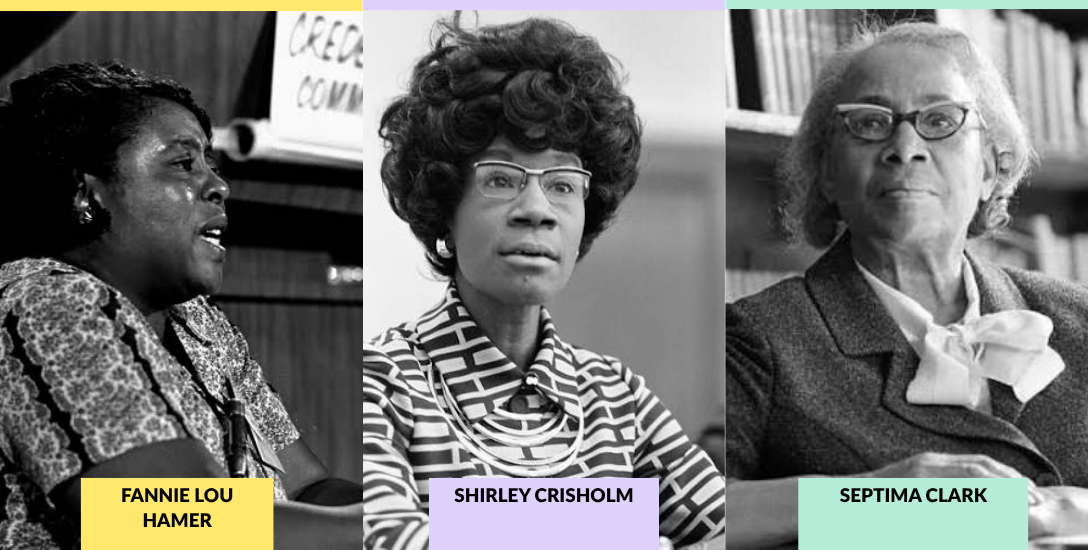
Before we could cast our ballots freely, Black women organized. Before we could enter rooms where decisions were made, Black women challenged the people guarding the doors.
Some became names we learn in history books. Others were our grandmothers, teachers, church mothers, and neighbors. They were the women who organized rides, shared information, and reminded us that our voices mattered.
As we begin October and GirlTREK’s We Want Power theme, we honor their legacy by asking: Who taught you what it means to use your power?
This week, we walk in the footsteps of three women whose work helped expand what was possible for Black women: Fannie Lou Hamer, Septima Clark, and Shirley Chisholm. Their stories offer lessons we can carry into our communities today.
Fannie Lou Hamer: Our voices belong in the decisions
Born on October 6, 1917, Fannie Lou Hamer became a voting rights organizer in Mississippi, where intimidation, discriminatory tests, and violence kept Black people from the ballot box.
In 1962, she lost her job after attempting to register to vote. She continued organizing despite threats and a brutal beating in jail. In 1964, she helped establish the Mississippi Freedom Democratic Party and challenged the exclusion of Black people from Mississippi’s delegation to the Democratic National Convention. Her testimony brought national attention to the violence behind that exclusion.
For Black women today, Hamer’s legacy offers a model for demanding accountability. She showed that the people living with injustice must have a voice in changing it.
We carry that lesson when we ask elected officials about conditions in our neighborhoods, help a sister access trustworthy voting information, or speak at a public meeting. Our experiences with work, caregiving, housing, and health belong in conversations about policy.
Walking in Hamer’s footsteps means trusting that what we know from our own lives matters.
Septima Clark: Knowledge is power we can share
Septima Clark was a teacher who understood how education could strengthen a community’s ability to act.
Working with organizers including Esau Jenkins and Bernice Robinson, she helped develop Citizenship Schools that taught Black adults reading, writing, and the skills needed to register to vote. At a time when discriminatory literacy requirements were used to deny Black citizens access to the ballot, these schools helped people navigate those barriers and prepared community members to become teachers and leaders themselves.
For Black women today, Clark’s work offers a powerful organizing practice: learn together, then share what you know.
We carry her legacy when we explain a confusing process without making someone feel ashamed, help a neighbor find reliable information, or create space for women to ask questions. A conversation on a walk can become the beginning of greater confidence and participation.
Clark reminds us that leadership can begin with patience, preparation, and a willingness to help someone else succeed.
Walking in Clark’s footsteps means making knowledge accessible and helping another woman recognize her own ability to lead.
Shirley Chisholm: Black women can set the agenda
In 1968, Shirley Chisholm became the first Black woman elected to Congress. In 1972, she sought the Democratic presidential nomination, becoming the first Black candidate to seek a major party’s nomination and the first woman to seek the Democratic nomination.
In Congress, she advocated for education, working families, and women’s rights. She also helped establish the Congressional Black Caucus and the National Women’s Political Caucus, building collective avenues for political influence.
For Black women today, Chisholm’s example expands our understanding of where we belong. We can organize a campaign, run for office, lead a coalition, and help decide which issues receive attention.
Her legacy also asks us to consider what we do once we have influence. Whose needs are we bringing forward? Which women are we helping enter the room?
Walking in Chisholm’s footsteps means seeing ourselves as people who make decisions and creating opportunities for others to lead.
What will we carry forward?
These women worked in different ways, but each helped more people participate in shaping their lives. Hamer organized and testified. Clark taught and developed leaders. Chisholm legislated and challenged political boundaries.
Their work gives us practices we can use today.
This week, take a 30 minute walk in their honor. Walk alone or with your crew, and ask: Who taught me to use my power? What did she make possible for me?
Say her name. Tell her story. Then choose one action to carry her lesson forward: share reliable civic information, learn about an issue affecting your neighborhood, attend a community meeting, or support a sister ready to lead.
The women who came before us left work for us to continue. Every time we organize, teach, speak, or make room for another Black woman, we help that legacy grow.
Whose footsteps are you walking in, and where will you lead next?