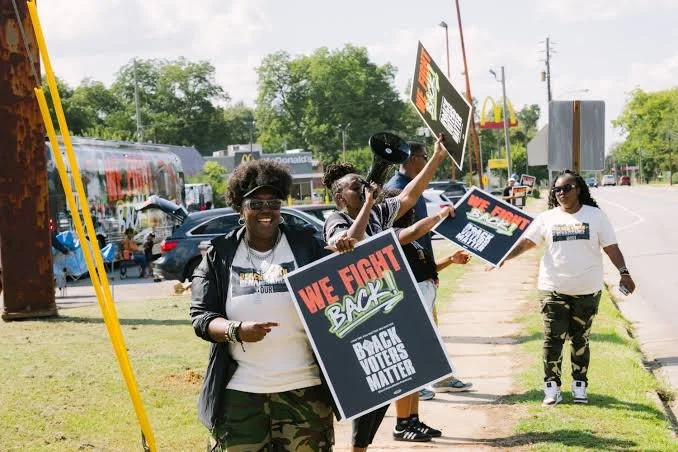
Black Voters Matter’s work offers a window into the history of voting rights and the everyday conditions that shape community participation.
An outstanding traffic warrant might seem far removed from a conversation about democracy. For someone trying to keep a job, secure housing, or navigate a suspended driver’s license, it can shape nearly every part of daily life.
Black Voters Matter addresses those concerns through community warrant clinics. Working with Growing Real Alternatives Everywhere, known as GRAE, and local partners, the organization helps people resolve certain misdemeanor and traffic warrants, seek reductions in fines and fees, and connect with support services. The clinics provide a community setting where participants can address their cases without fear of arrest.
That work offers a revealing introduction to an organization whose name is closely associated with elections.
Black Voters Matter’s stated purpose is to increase power in marginalized, predominantly Black communities. Its approach includes voter registration and turnout, advocacy, training, and support for local organizations. It emphasizes the relationships and resources that sustain civic engagement throughout the year.
For GirlTREK’s We Want Power campaign, this story provides an opportunity to explore what power means in practice: having a voice, understanding the decisions that affect daily life, and examining the conditions that make participation possible.
Starting Where People Are
In a statement published on Black Voters Matter’s website, co-founder Cliff Albright described a central organizing principle:
“We’ve got to engage people where they are.”
The warrant clinics give that principle a concrete form. They address problems participants are already navigating, often involving consequences that extend beyond the original traffic or misdemeanor case.
The organization’s 2023 impact report documented eight clinics in Georgia, Michigan, and Louisiana, reporting 704 warrants cleared and $280,000 in fines and court costs forgiven. These results represent a specific reporting year, but they illustrate the practical reach of the program.
Resolving a traffic case does not automatically change someone’s voting eligibility. The broader connection is between community participation and the circumstances surrounding it: transportation, financial pressure, access to assistance, and relationships with public institutions.
Black Voters Matter’s other campaigns reflect that wider view. Its website describes Sick & Tired as focused on healthcare justice, Medicaid expansion, and Black health equity. Take the Field engages students around significant issues. We Got Us brings together mutual aid, political education, and grassroots organizing.
Together, these programs show how the organization connects public policy with everyday experience.
The History Behind the Work
The distance between a legal right and the ability to exercise it runs throughout American voting history.
A constitutional amendment can establish a protection. Local practices can obstruct it. Federal legislation can strengthen enforcement. A court ruling can change what that enforcement allows.
These selected milestones trace the development of voter suppression and the struggle to overcome it.
1870: A Constitutional Promise
The Fifteenth Amendment, ratified on February 3, 1870, prohibited denying or restricting voting rights because of race, color, or previous enslavement.
For Black men following slavery and the Civil War, it represented a profound constitutional change. Yet discriminatory laws, administrative practices, and intimidation continued to obstruct access to the ballot.
Late 1800s Through the Jim Crow Era: Barriers Multiply
Poll taxes, literacy tests, grandfather clauses, and intimidation became tools for disenfranchising Black citizens.
These methods reinforced one another. Poll taxes imposed financial obstacles. Literacy tests gave discriminatory officials opportunities to reject applicants. Grandfather clauses could exempt people whose ancestors had been eligible to vote before emancipation, preserving access for white citizens while excluding many Black citizens.
Threats and violence made asserting the right dangerous. Together, these practices denied participation despite constitutional protection.
1920: Women’s Suffrage Expands, but Exclusion Persists
Ratification of the Nineteenth Amendment prohibited denying voting rights on the basis of sex. Black women participated in elections where they could, but racial barriers continued to block many from registering and voting.
The amendment was a major victory, while the struggle for equal access continued. Black women remained active in the organizing that followed.
1964: Poll Taxes Are Prohibited in Federal Elections
The Twenty-Fourth Amendment prohibited poll taxes in federal elections.
It addressed a financial barrier long used against people with low incomes and people of color. Its scope matters: the amendment applied to federal elections, rather than immediately ending poll taxes in every state and local contest.
March 1965: Bloody Sunday Exposes the Violence
On March 7, approximately 600 voting rights demonstrators attempted to march from Selma toward Montgomery, Alabama.
At the Edmund Pettus Bridge, state troopers and a sheriff’s posse confronted and attacked them. The day became known as Bloody Sunday.
The marchers were demanding access to a right already promised to them. The violence exposed how force supported the system of exclusion they were challenging.
August 1965: The Voting Rights Act Strengthens Enforcement
President Lyndon B. Johnson signed the Voting Rights Act on August 6.
The law targeted discriminatory voting practices, including literacy tests in covered jurisdictions, and established stronger federal enforcement. Federal examiners could register qualified citizens in certain jurisdictions with histories of discrimination.
It addressed a persistent problem: constitutional guarantees had proved insufficient when authorities responsible for administering elections were also obstructing access.
2013: Shelby County v. Holder Changes Federal Oversight
The Supreme Court invalidated the formula determining which jurisdictions were subject to the Voting Rights Act’s preclearance requirement.
Under preclearance, covered jurisdictions needed federal approval before implementing voting changes. Without the existing formula, that system could no longer function on its previous basis.
Other protections remained, but the ruling changed the ability to prevent discriminatory changes before they took effect.
2021: Brnovich Changes the Standards for Challenges
In Brnovich v. Democratic National Committee, the Supreme Court upheld Arizona policies involving out-of-precinct ballots and restrictions on who could return another person’s early ballot.
The Brennan Center for Justice describes the decision as making discriminatory voting rules harder to challenge under Section 2 of the Voting Rights Act.
The case illustrates how legal standards shape the reach of a protection, even when the statute remains in place.
2026: Louisiana v. Callais Reshapes Redistricting Protections
On April 29, the Supreme Court affirmed a ruling that Louisiana’s congressional map containing a second majority-Black district was an unconstitutional racial gerrymander.
The majority interpreted Section 2’s redistricting protections to require circumstances supporting a strong inference of intentional racial discrimination. The dissent argued that the decision undermined Congress’s protection against unequal electoral opportunity.
The dispute concerns how votes translate into representation. Access to a ballot and the opportunity to elect preferred representatives are connected, but distinct, questions.
Through September 2026: Voting Access Continues to Change
The Brennan Center’s October 2026 roundup reported that at least 22 states enacted 47 laws it classified as restrictive between the 2024 election and September 1, 2026. Many tightened documentary or identification requirements.
During the same period, at least 32 states enacted 61 laws the organization classified as expanding access.
These classifications reflect the organization’s assessment of enacted legislation, rather than a judicial finding that every restriction is unlawful. They also reveal a changing landscape in which voters’ experiences depend heavily on where they live.
The Work That Continues Between Elections
Across this history, changes in law have repeatedly altered the conditions of participation. Understanding those changes, explaining them, and helping people navigate them takes sustained work.
Black Voters Matter’s purpose page emphasizes respecting existing community networks, reaching rural counties and smaller towns, and investing in Black women’s leadership. It identifies those commitments as central to its mission.
Its programs show how that mission extends into daily life. A warrant clinic responds to an immediate legal concern. A healthcare campaign connects public decisions with access to care. Training supports people working within their communities.
These examples make an abstract idea more tangible. Community power involves resources, knowledge, relationships, and the ability to address problems over time.
We Want Power: Connecting the Conversation
GirlTREK’s We Want Power campaign creates space to consider what power means in everyday life. The story of Black Voters Matter adds historical and practical context to that conversation: how people gain a voice, what stands in their way, and what it takes to sustain their participation.
The timeline reveals the distance between a right being recognized and a person being able to exercise it. Constitutional protections mattered. So did the people who explained those protections, challenged discriminatory practices, and helped their neighbors navigate the process.
For this month’s exploration, those examples offer something concrete to examine. Power can involve having reliable information, being heard in a public decision, or having the resources to address a problem. It can also involve the relationships that make asking for help possible.
A walk together can create room to talk about those experiences. What decisions affect daily life? Where do people feel heard? What makes participation difficult? Listening to the answers helps make the conversation personal and specific.
In a statement on Black Voters Matter’s website, co-founder LaTosha Brown said:
“We must see ourselves as founders of the America still to come.”
Her words introduce a question that belongs within this month’s reflection: What does having a role in shaping the future look like in ordinary life?
We Want Power offers room to sit with that question, drawing connections between personal experience, community relationships, and the history that brought us here.
On your next walk, reflect: When have you felt that your voice mattered, and what made that possible?
Learn more about Black Voters Matter’s purpose and programs.