At a family table, care can take familiar forms: a recipe passed down, a story told again, someone asking whether you made it home. An empty seat can hold its own history. So can the chair of the woman who prepared the meal but has barely had time to sit.
These moments belong in the conversation about Black family health. So do the conditions that determine whether families have time together, support for their children and help when someone becomes ill.
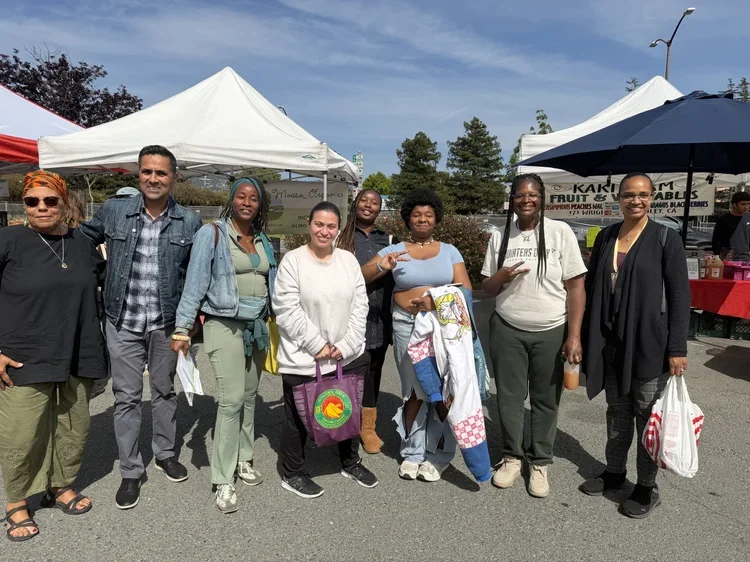
In Berkeley, California, Healthy Black Families approaches that work through parenting support, nutrition education, storytelling and youth programs. Founded in 2013 by Dr. Vicki Alexander, the nonprofit connects everyday family needs with a mission to make social systems more equitable for Black people and communities.
For GirlTrek, that conversation extends beyond exercise. Its Joy and Justice agenda calls for healthy families alongside economic security and care for caregivers. The agenda connects family separation to slavery, colonization and mass incarceration, while advocating for jobs, affordable child care, addiction treatment, an end to cash bail and paid kinship care.
Across both organizations’ work is a question that reaches into our own families: Who is caring for the people who care for everyone else?
The history families carry
Black people have built and sustained families through conditions that repeatedly threatened their ability to remain together.
Under slavery, marriages between enslaved people lacked legal recognition, and parents could not protect their children from sale. After emancipation, freed people searched for relatives who had been taken from them. The Smithsonian’s National Museum of African American History and Culture documents those searches and the enduring significance of family reunions.
That history matters when discussing family structure today. Separation cannot be understood only as a private matter when laws and institutions have helped produce it.
Looking at family life through sociology means examining how public decisions shape private possibilities. A parent’s work schedule, the cost of child care and access to paid leave affect who can show up and how often. Love exists within those conditions; families still need resources to act on it.
Black people have also built institutions, maintained kinship networks and preserved traditions through those pressures. The history of family separation belongs beside the history of people searching for one another, organizing reunions and making care possible across generations.
Recognizing the family that is already there
The intersectionality of the Black family is something to be revered, appreciated and upheld as part of the very fabric through which we understand Blackness. It carries our traditions as well as our increasing understanding of ourselves, our surroundings and our neighborhoods.
There is no single Black family experience. Class, gender, sexuality, disability, geography and migration shape how people build households and find support. Intersectionality asks us to consider how these experiences overlap with systems of power: A Black mother with a disability, for example, may navigate barriers that cannot be understood through race, gender or disability alone.
Family can include grandparents raising children, relatives sharing a home, a single parent, two parents, queer partners and chosen kin. The people providing care may live across the hall or across the country.
Kinship also extends beyond biological and legal relationships. Sociologists sometimes describe these bonds as fictive kinship. In everyday life, they may mean a neighbor called auntie, a longtime family friend or a chosen sibling who shows up when needed.
Recognizing family also requires attention to inclusion. Black queer and transgender relatives, people with disabilities and those whose lives differ from older generations’ expectations need belonging that does not depend on concealing themselves. Respecting someone’s name, making gatherings accessible and listening without humiliation are everyday ways to practice that belonging.
Family health can be measured in the safety people feel, the support they can depend on and their ability to ask for help without humiliation.
It also asks who carries the work. A family may appear to be functioning while one woman manages every appointment, meal, emergency and difficult conversation. Celebrating her strength should come with a willingness to share her responsibilities.
From Berkeley to the world
Healthy Black Families’ services are rooted in Berkeley. Its local work offers lessons for communities elsewhere: Build trusted relationships, make cultural connection part of care and give families a voice in the support designed for them.
The programs described here serve specific communities and school settings; their wider relevance lies in those practices. Some activities are virtual, while others bring families together through local schools and community spaces.
“Regeneration isn’t just about growth; it’s about healing,” Wilhelmenia “Mina” Wilson, the organization’s executive director, has said.
That approach gives family health a practical reach, from the questions a new parent brings to a peer circle to the stories a young person chooses to tell.
Support for mothers and young children
Sisters Together Empowering Peers, known as STEP, offers monthly virtual motherhood circles, leadership training, community gatherings and culturally responsive workshops.
The program began in 2002 to support Black mothers transitioning from Berkeley’s Black Infant Health program. It became part of Healthy Black Families in 2013, according to the organization’s history.
Its kindergarten readiness initiative helps parents and caregivers of children from birth through age 5 understand early development, navigate access to quality child care and prepare for school.
Partners include Berkeley’s Black Infant Health program, the Youth Equity Partnership and Berkeley Unified School District. Educational forums address early learning, toxic stress, racism and family stability. Families can participate through STEP meetings, workshops and community events.
For a parent trying to understand a school system or a child’s next stage of development, a trusted peer network offers somewhere to bring questions.
Nutrition education families can use
Thirsty 4 Change! brings nutrition and hydration education into everyday community settings. Activities include gardening, cooking demonstrations and farmers market walks.
The program also includes Youth Water Ambassadors, which educates residents about sugar-sweetened beverages. Partners include the Center for Food, Faith and Justice, McGee Avenue Baptist Church and The Way Christian Center.
The organization advertises free virtual Shop Smart, Eat Healthy nutrition classes and in-person farmers market walks.
Food traditions can hold pleasure, memory and connection. Building healthy routines around them also requires attention to what a household can afford, where it can shop and who has time to cook.
Black women telling their own stories
Telling Our Stories, established in 2019, offers six-week writing circles where Black women reflect on their lives and develop original work. The program works with local authors, wellness practitioners and community partners.
Participants’ work has appeared in the “What We Carry: Stories Black Women Never Tell” series. The program also includes book events and podcast conversations.
“If we do not tell our truths ourselves, others will define our truths,” program coordinator Deborah Hailu has said.
The ability to tell one’s own story matters when Black family life is so often discussed through hardship. Writing makes space for the affection, humor, conflict, ambition and ordinary experiences that a statistic cannot hold.
Cultural connection for young people
The Village Cultural Academy’s Art of Storytelling program serves students at Longfellow Middle School in Berkeley. It uses writing, storytelling and art to help students explore identity, family history and cultural traditions.
The organization describes the program as open to all students, with intentional attention to African American students’ experiences and cultural heritage. Activities emphasize literacy, reflection, confidence and creative expression, culminating in a student showcase.
Interested families are directed to Longfellow program staff for information about workshops and showcases. The City of Berkeley also lists the academy among its resources for Black and Latinx children and youth.
For families, the invitation is intergenerational: Young people can explore where they come from while contributing their own understanding of who they are.
Turning connection into organized care
GirlTrek’s work begins with Black women making time for their own health and building relationships through walking. Its Care Villages connect movement and sisterhood with local action.
That practice has implications for the whole family. Time set aside for a woman’s walk asks the people around her to recognize that her needs belong on the calendar, too.
Healthy Black Families’ programs and GirlTrek’s organizing offer complementary examples of community care. Families bring knowledge about what needs to change, and organizations can create ways for that knowledge to guide decisions.
Inside our families, that work becomes specific: taking a recurring caregiving shift, arranging a ride or checking in after everyone else has stopped calling.
Family health also requires institutional responsibility. Access to affordable child care, paid leave and quality health care gives families practical support for the care they provide. Community action and public policy must meet that everyday work.
A shared caregiving calendar can also make responsibilities visible. One relative can handle transportation, another can make calls and another can take a recurring shift. Agreeing on tasks helps turn a general promise of support into time someone can count on.
Organizations have responsibilities here, too. Meeting times, transportation, disability accommodations and child care can determine who participates. Asking families what they need must include listening to the people who cannot get into the room.
Making room for empty seats
An empty seat can mean someone has died. It can mean a loved one is incarcerated, far away or no longer in contact. Those absences carry different needs, and families deserve room to name them honestly.
When someone is incarcerated or living far away, connection might involve letters, calls or help navigating visits, when wanted and possible. When an absence follows harm, protecting a boundary can also be part of family health. Reunion should allow for safety, accountability and consent.
“It’s hard to heal with people who have harmed you,” Wilson has said about domestic violence.
Honoring family includes respecting the distance someone needs to be safe. A gathering should never require a person to accept mistreatment as the price of belonging.
The people still at the table need attention, too: the child asking questions, the caregiver adjusting to a changed role, the relative quietly facing a first holiday alone.
Before a gathering, ask privately what would feel supportive. Someone may want to say a loved one’s name, display a photograph or prepare their recipe. Another may prefer a quiet observance or permission to step away. Neither response needs to become a test of love.
A child can be invited to ask questions without being required to comfort adults. A grieving relative can receive a specific check-in the following week. Meal preparation and cleanup can be shared so the work does not fall on the person already carrying the most.
Chosen family can have a place at the table, too. Inviting a trusted friend or neighbor can widen the circle of care while preserving the significance of the person who is missing.
How families can connect
Healthy Black Families lists its office at 2927 Adeline St., Berkeley, CA 94703. Its contact page directs visitors to schedule an office appointment.
Families can email info@healthyblackfam.org or call 510-285-6689 to ask about participation, accessibility, eligibility and upcoming activities. Program pages link to STEP registration and free virtual nutrition classes. Families interested in the Village Cultural Academy should connect with Longfellow Middle School program staff.
Readers can also explore writing circles, book events and storytelling programs. Contact staff for current schedules and openings.
A next step for our own families
This week, invite a relative or someone you consider family to walk with you. Make room for one question: What are you carrying that we could help you carry?
Listen to the answer, then agree on one thing you can do. Take a caregiving shift. Make the appointment. Call the relative who has grown quiet. Ask an elder to share a story, and let a young person tell theirs.
The work also extends beyond our households: supporting community organizations, participating in local decisions and advocating for the resources families need to care for one another.
We uphold the Black family through the traditions we carry forward and the choices we make about how to care for one another now. That includes making room for grief alongside joy — and making sure the person who always sets the table has somewhere to sit.
Reporting sources
Healthy Black Families, About: https://healthyblackfam.org/about
Healthy Black Families, Sisters Together Empowering Peers: https://healthyblackfam.org/step
Healthy Black Families, Telling Our Stories: https://healthyblackfam.org/tos
GirlTrek, Mission and Joy and Justice agenda: https://www.girltrek.org/about-us/mission/
National Museum of African American History and Culture, The Historical Legacy of Black Family Reunions: https://nmaahc.si.edu/explore/stories/historical-legacy-black-family-reunions
Library of Congress, Enslaved Families: https://www.loc.gov/exhibitions/two-georges/access-text/enslaved-families/